Legal Technology Training Program
(2-day event)
Presented by: The NSU Law Technology and Innovation Program in
Conjunction with the National Society of Legal Technology
Friday, January 16, 2026 | 1:00 p.m. - 5:30 p.m.
AND
Friday, January 23, 2026 | 1:00 p.m. - 5:30 p.m.
NSU Shepard Broad College of Law | Davie, Florida
Cost to Attend:
FREE for Students, December 2026 NSU Law Graduates, Non-Profit and government workers, Judiciary
$300 (NSU Alumni Attorneys)
$350 (Attorneys from General Public)
Additional Cost: $75 Materials Fee that will be paid directly to NSLT (Free to students)
The program provides lawyers and law students an opportunity for hand’s on training and essential training on the fundamentals for using artificial intelligence and other technologies in the practice of law. CLE credits are available for attorneys and an NSLT certification is available for law students and paralegals.
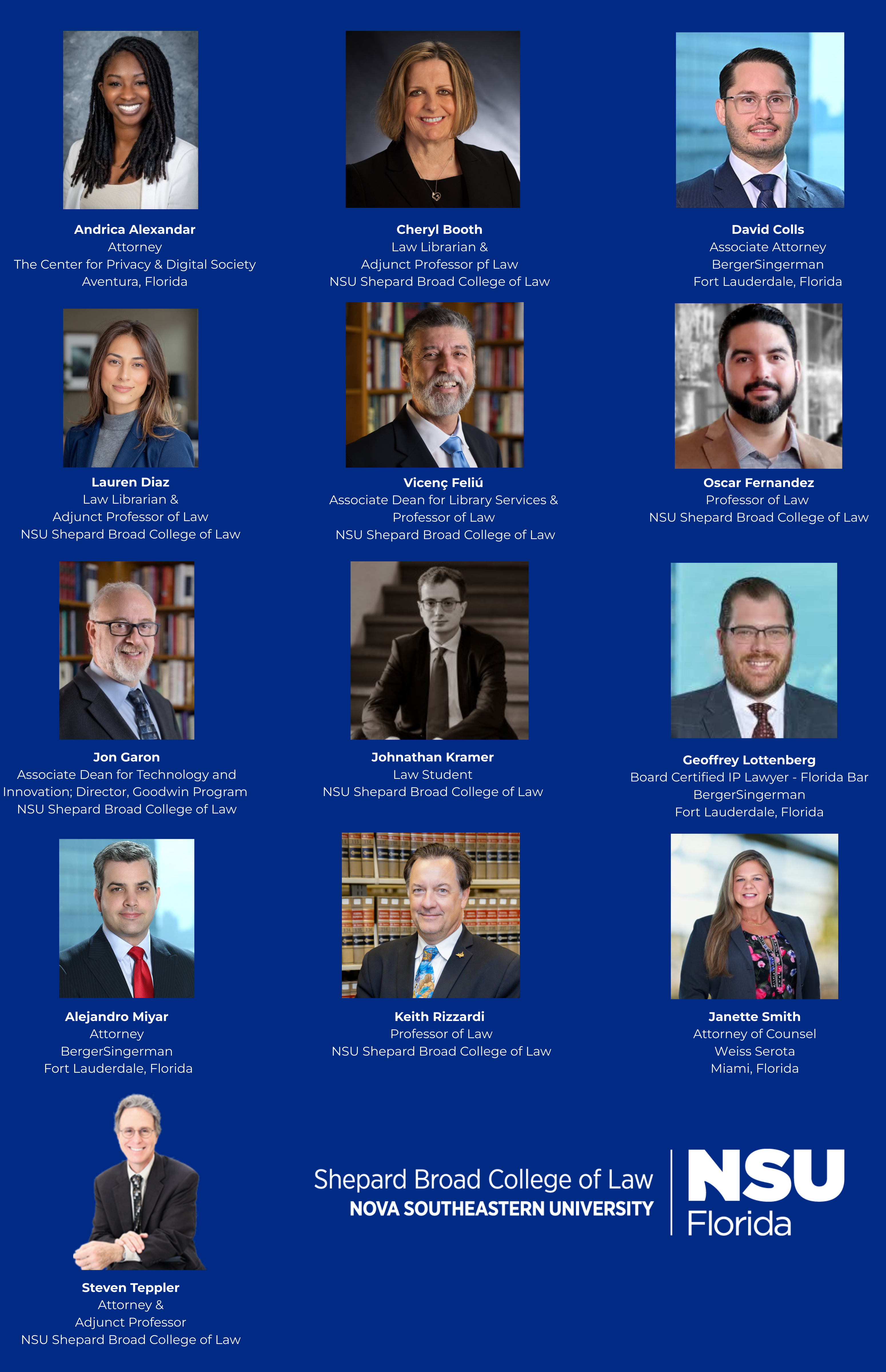
SPEAKERS BIOGRAPHIES DETAILED AGENDA
The NSU Shepard Broad College of Law's Technology and Innovation Program is hosting an exciting 2-day Training CLE event. This program will be presented live as well as recorded.
Program Description:
Technology is rapidly reshaping every facet of legal practice, from research and evidence collection to client communication and case management. Today’s legal professionals must not only understand emerging tools—they must know how to use them responsibly, ethically, and effectively.
This two-day training program provides a comprehensive, practice-focused exploration of the technologies transforming the profession. Participants will engage with foundational concepts, generative AI tools, digital evidence practices, privacy and cybersecurity requirements, eDiscovery platforms, and the ethical duties that govern technology use in law.
Through hands-on instruction and expert-led sessions, attendees will build practical skills in AI-assisted research, prompt drafting, digital forensics, practice management systems, and more. The program emphasizes real-world application, professional responsibility, and the critical judgment required to navigate rapidly evolving technological environments.
Whether you are a law student preparing for modern practice or a legal professional seeking to enhance your technical competency, this program delivers the essential knowledge and skills needed to thrive in today’s digital legal landscape.
This is a 2-DAY CLE
Everyone is welcome!
CLE Credits Pending
REGISTER HERE
or Scan Below
For additional information about this program, including sponsorship opportunities, please contact Jon Garon, Associate Dean for Technology and Innovation and Director, Goodwin Program for Society, Technology, and the Law, at garon@nova.edu.
As an institutional contributor to the Technology and Innovation program at Nova Southeastern University Shepard Broad College of Law (NSU Law), your contribution enables us to bring essential and timely training to students, faculty, and staff. These efforts help ensure that NSU Law graduates are able to take advantage of the newest tools available in the legal marketplace, to use those tools ethically and confidently, and to provide leadership on the future of the practice of law for their employers.
Your investment in NSU Law will support the efforts during this academic year (through June 30, 2026). We seek annual donors to support the education, training, and outreach. Learn more by clicking here.
Session Descriptions:
Day 1 - Session 1:
Welcome, Overview, and Fundamentals of Legal Technology (Jon Garon): This opening session introduces participants to the evolving landscape of legal technology, covering essential tools and platforms that modern legal professionals use daily. Attendees will learn how technology enhances efficiency, improves client service, and transforms traditional legal practice. The session establishes foundational concepts necessary for understanding subsequent advanced topics.
Professional Responsibility Requirements (Jon Garon): Participants explore ethical obligations surrounding technology use in legal practice, including competence requirements the ABA Model Rules. The session addresses attorney duties regarding technology proficiency, data security, confidentiality protection, supervisory responsibilities, online marketing, and more. Attendees learn how professional conduct rules apply to digital communications, cloud storage, and emerging technologies.
Overview of AI, Deepfakes, and Ethical Considerations (Janette Smith): This segment examines artificial intelligence applications in legal practice and associated risks, including deepfake technology's implications for evidence authenticity. Participants discuss ethical challenges posed by AI-generated content, verification responsibilities, and potential impacts on litigation. The session emphasizes critical thinking when evaluating digital evidence and AI outputs.
Ethical Disclosures to Clients and PR Issues (Andrica Alexandar): This session addresses transparency obligations when using AI and technology in client representation. Participants learn when and how to disclose technology use, associated risks, and data handling practices. The session also covers public relations considerations, reputational risks, and communication strategies when technology failures or security incidents occur.
Day 1 - Session 2:
Generative Artificial Intelligence (Keith Rizzardi): Attendees gain comprehensive understanding of generative AI tools like ChatGPT and their applications in legal research, document drafting, and analysis. The session covers capabilities, limitations, and potential pitfalls including hallucinations and accuracy concerns. Participants learn best practices for integrating generative AI while maintaining professional responsibility standards and quality control.
Prompt Drafting (Oscar Fernandez): This practical session teaches effective prompt engineering techniques to maximize AI tool utility and accuracy. Participants learn how prompt structure, specificity, and context influence AI outputs. Through hands-on exercises, attendees develop skills in crafting prompts that yield reliable, relevant results while understanding how to iteratively refine queries for optimal outcomes.
AI in Legal Research (Lauren Diaz): This session introduces students to the use of generative artificial intelligence in legal research and practice. Emphasis is placed on integrating AI with traditional research methods, evaluating accuracy, preventing errors such as “hallucinated” citations, and ensuring ethical use. Students will gain practical experience comparing AI-generated results with conventional sources and will develop the skills to responsibly incorporate AI into legal research workflows.
Using AI in Legal Practice and Legal Education (Janette Smith, Johnathan Kramer): Participants address the best practices for use of Generative AI to improve efficiency while avoiding hallucinations and adhering to the ethical obligations of lawyers and law students. Participants examine the use cases for AI tools to legal research, contract analysis, litigation support, and client intake processes while discussing those areas where the tools become counterproductive. In the law school setting, attendees learn strategies for responsible AI adoption that enhances rather than replaces critical legal reasoning and professional judgment.
Day 2 - Session 3:
Privacy (Cheryl Booth): Attendees examine privacy laws affecting legal practice across state, federal, and relevant international law as well as attorney-client privilege considerations in digital contexts. Focused on legal technologies, the session covers data minimization principles, consent requirements, cybersecurity essentials, and cross-border data transfer restrictions. Participants learn to implement privacy-protective practices while using legal technology platforms and managing sensitive client information effectively.
IP Protections, including Trade Secret Protection (Vicenç Feliú): This segment explores intellectual property considerations in legal technology contexts, emphasizing trade secret identification and protection strategies and methods to ensure patent eligibility. Participants learn about confidentiality agreements, employee training obligations, and technological safeguards. The session addresses IP ownership questions arising from AI-generated work product and collaborative technology platforms.
Online Evidence Collection (Geoffrey Lottenberg, Alejandro Miyar): Attendees learn proper methodologies for collecting, preserving, and authenticating digital evidence from websites, social media, and online sources. The session covers chain of custody requirements, metadata preservation, and admissibility standards. Participants practice using specialized tools while understanding legal and ethical constraints on evidence gathering techniques.
Cybersecurity (Steven Teppler): This critical session addresses cyber threat landscapes affecting law firms and legal departments. Participants learn about common attack vectors, ransomware risks, and incident response protocols. The session covers encryption, multi-factor authentication, network security fundamentals, and creating cybersecurity policies that comply with professional responsibility requirements.
Day 2 - Session 4:
eDiscovery (David Colls): This session introduces RelativityOne eDiscovery platform, covering document review workflows, search techniques, and artificial intelligence-assisted review functions. Participants learn to manage large document collections efficiently, apply predictive coding, and generate production sets. The session emphasizes practical skills for managing discovery in complex litigation matters.
Introduction to Digital Forensics (Geoffrey Lottenberg): Attendees explore digital forensics fundamentals including data recovery, device examination, and forensic analysis methodologies. The session covers when to engage forensic experts, evidence preservation requirements, and forensic report interpretation. Participants learn to recognize situations requiring forensic investigation and understand limitations of various forensic techniques.
Case Management, Time Tracking, Billing, and eFiling (Cheryl Booth): This practical session demonstrates comprehensive practice management platform for organizing matters, tracking time, and generating client invoices. Participants learn workflow automation, client communication tools, and financial reporting capabilities. The session emphasizes efficiency gains and improved client service through integrated practice management technology. Attendees also receive concise training on electronic court filing systems and Adobe Acrobat tools essential for legal practice. The session covers document preparation, PDF manipulation, redaction techniques, and filing protocol compliance.
Final Considerations, Prompt Bias, Selection Bias, and Knowing What You Don't Know (Alejandro Miyar, Jon Garon, Janette Smith, Andrica Alexandar): This session examines how biases embedded in AI training data and prompt construction can skew outputs which can impact use in legal practice. The session covers identifying selection bias in case law research, document review, and predictive analytics. Participants learn validation techniques and develop awareness of sampling limitations that affect technology-assisted legal work. Participants also explore overconfidence risks with AI tools, and knowing when to seek expert assistance. The session reinforces commitment to ongoing learning, appropriate supervision, and maintaining professional standards in rapidly evolving technological landscapes.